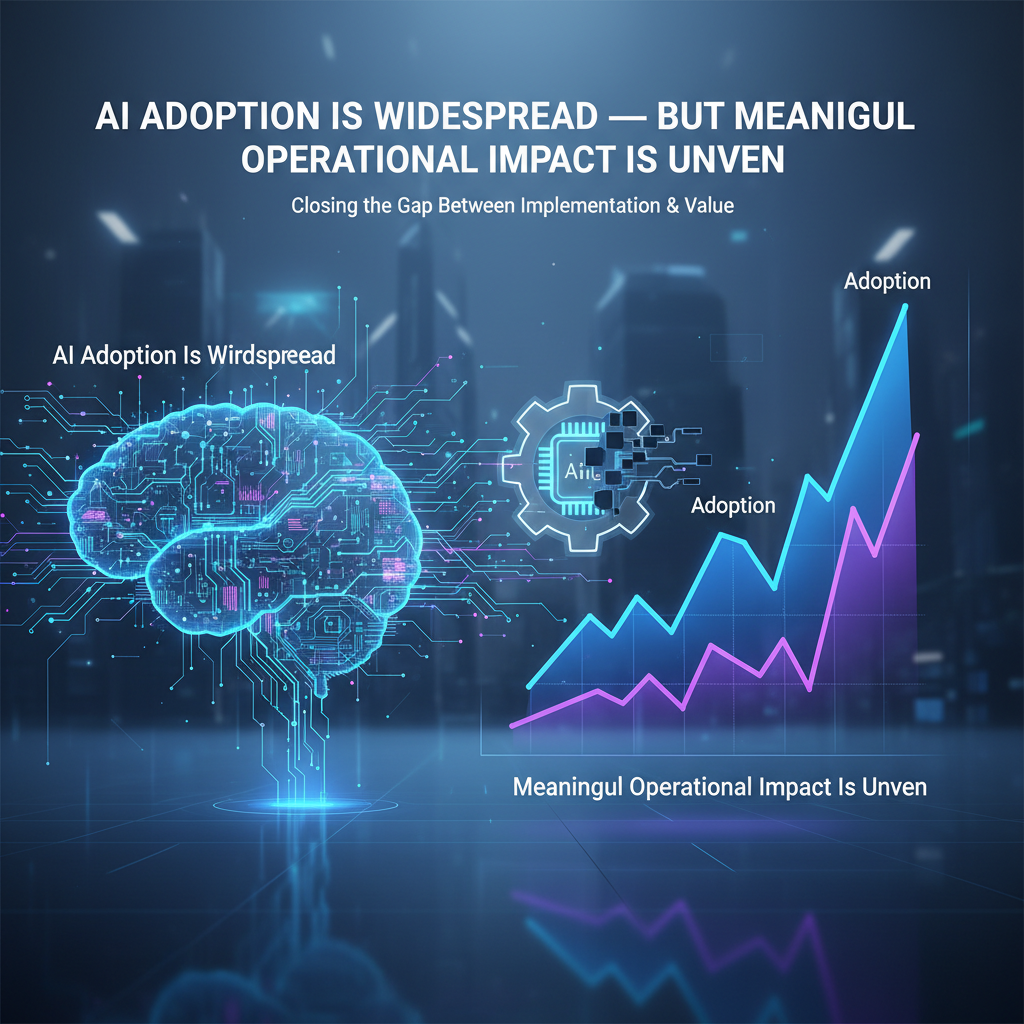
The AI-First Paradox
When the mandate is clear but the path is not
In the last year, a quiet shift has happened inside large organizations. AI is no longer introduced as an experiment or a future initiative. It is now positioned as a default way of working. Business teams are being encouraged—sometimes instructed—to "think AI-first" while planning processes, handling volume, or improving productivity.
On paper, this sounds progressive and empowering. In reality, the experience on the ground is far more nuanced. This article explores what actually happens when non-technical teams are asked to adopt an AI-first mindset, why hesitation is more rational than resistance, and what leaders can do to make AI feel usable, safe, and genuinely helpful in everyday work.
The Ask Sounds Simple, Almost Obvious
From a leadership perspective, the instruction feels reasonable. AI tools are available. Vendors promise efficiency. Competitors are moving. So business teams are told to start using AI in their daily work—whether that is HR teams drafting policies, operations teams managing workflows, finance teams analyzing data, or support teams handling queries.
The message is often framed positively: "Use AI to work smarter." "Let AI take the first pass." "Explore what AI can do for your role." There is no aggressive pushback in meetings. Heads nod. Teams agree. Curiosity exists.
⚠️ But this simplicity is deceptive. "Think AI-first" assumes that people know where AI fits, what is acceptable, and how far they can go. For non-technical teams, these assumptions are rarely true.
What Teams Experience in Practice
Once teams return to their desks, the real questions begin.
Most non-technical professionals are not against AI. In fact, many are already using it quietly. The friction comes from ambiguity. Tools are available, but boundaries are not clear. Guidance is generic. Policies are written broadly to reduce risk, not to enable action.
The Result
As a result, teams either overuse AI without confidence or underuse it out of caution. Neither leads to consistent productivity gains. Instead of AI becoming a daily assistant, it becomes something people use selectively and silently. Organizations implementing AI sandboxes are finding better ways to bridge this gap.
Why Hesitation Is Rational, Not Resistance
💡 Key Insight
It is tempting to label slow adoption as reluctance. That would be a mistake.
Non-technical teams operate in environments where errors have consequences. A wrong number in finance, a poorly worded HR communication, or an incorrect operational decision can create real problems. When AI enters this environment without clear guardrails, hesitation becomes a form of risk management.
Professional Pride
Many take pride in their expertise. AI without context feels like replacement, not support.
Responsibility Uncertainty
Without clear accountability, hesitation is rational risk management.
There is also a human dimension. When AI is introduced without context, it can feel like their judgment is being replaced rather than supported. Without seeing how AI complements their role, people naturally pull back. This is not fear of technology. It is uncertainty about responsibility. Until that uncertainty is addressed, adoption will remain uneven.
The Hidden Cost of Unclear AI Adoption
When teams are unsure, something subtle happens. AI becomes an individual experiment rather than an organizational capability. Some people explore. Others wait. Knowledge does not spread evenly. Best practices do not emerge.
The Adoption Gap Over Time
The gap between leadership expectations and actual team adoption
Over time, leadership sees mixed results. A few success stories are highlighted, but they are hard to replicate. This creates a gap between expectations and reality. The narrative becomes, "We gave teams AI, but impact is limited." The issue is not effort. It is structure. Without a safe and shared way to explore AI, teams are left to interpret "AI-first" on their own.
What Changes When Experimentation Feels Safe
The dynamic shifts when teams are given a space to try AI without pressure. When experimentation is clearly separated from production systems, people relax. They test ideas. They ask better questions. They learn what works and what does not in the context of their own role.
When Teams Feel Safe to Experiment
Instead of abstract use cases, teams see AI applied to familiar tasks—drafting responses, prioritizing work, summarizing information, or supporting decisions. Confidence grows not because of training sessions, but because people see outcomes in their own workflow. This is where AI starts to feel practical rather than aspirational. Teams exploring AI capability building understand this shift.
From Curiosity to Confidence at the Role Level
One of the most overlooked aspects of AI adoption is role specificity. Non-technical teams do not work in generic functions. They work in roles with clear responsibilities, constraints, and metrics.
When AI is introduced at the role level, adoption accelerates. People understand where AI helps and where human judgment remains essential. The question shifts from "Should I use AI?" to "Which part of my work benefits from AI support?"
This clarity reduces anxiety. It also makes conversations between business teams and leadership more concrete. Instead of debating tools, they discuss outcomes.
How Leaders Can Lower the Entry Barrier
For CIOs and Heads of Operations, the goal is not to push harder. It is to make entry easier.
Leadership Enablement Framework
Create spaces where teams can explore AI without technical setup, data risk, or fear of mistakes
Provide structure instead of leaving exploration entirely open-ended
Accept that adoption is a journey, not a switch. Teams need time to build familiarity
That means providing environments where non-technical teams can explore AI without technical setup, without data risk, and without fear of making mistakes. It means guiding experimentation instead of leaving it entirely open-ended. Most importantly, it means acknowledging that adoption is a learning curve, not a switch. Teams need time to build familiarity before productivity improvements become visible. When leaders design for this reality, AI adoption becomes steadier and more sustainable.
Where Product Thinking Quietly Matters
At this stage, the conversation shifts from policy to enablement. Organizations that see progress are not asking teams to "use more AI." They are giving them structured ways to experience AI in their daily context. No-code environments. Guided workflows. Clear boundaries between exploration and deployment.
This approach does not overwhelm teams with tools. It builds confidence through doing. Over time, AI stops being a special initiative and becomes part of how work gets done.
Explore how Ambilio's AI products help teams transition from policy to practice.
Closing Thought
Asking non-technical teams to "think AI-first" is not wrong. But it is incomplete.
The real work lies in helping people understand how AI fits into their role, where it adds value, and how to use it safely. When that understanding is built through experience rather than instruction, adoption follows naturally.
In 2026, the organizations that move forward will not be the ones with the loudest AI vision. They will be the ones that quietly helped their teams become comfortable using AI, one role and one workflow at a time.
Ready to Enable Your Teams?
Discover how structured AI environments help non-technical teams transition from hesitation to confidence.
Explore AI Consulting →